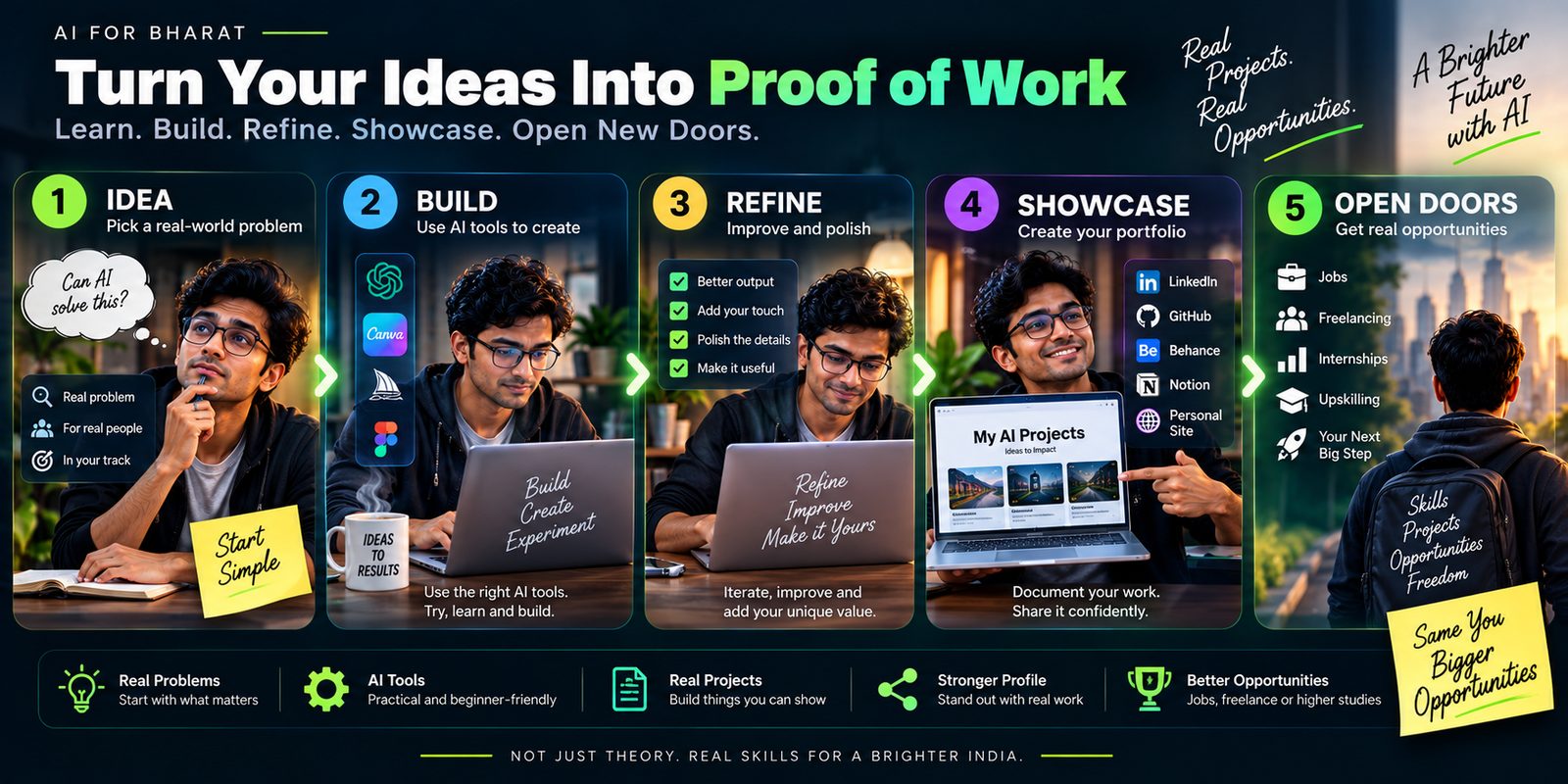
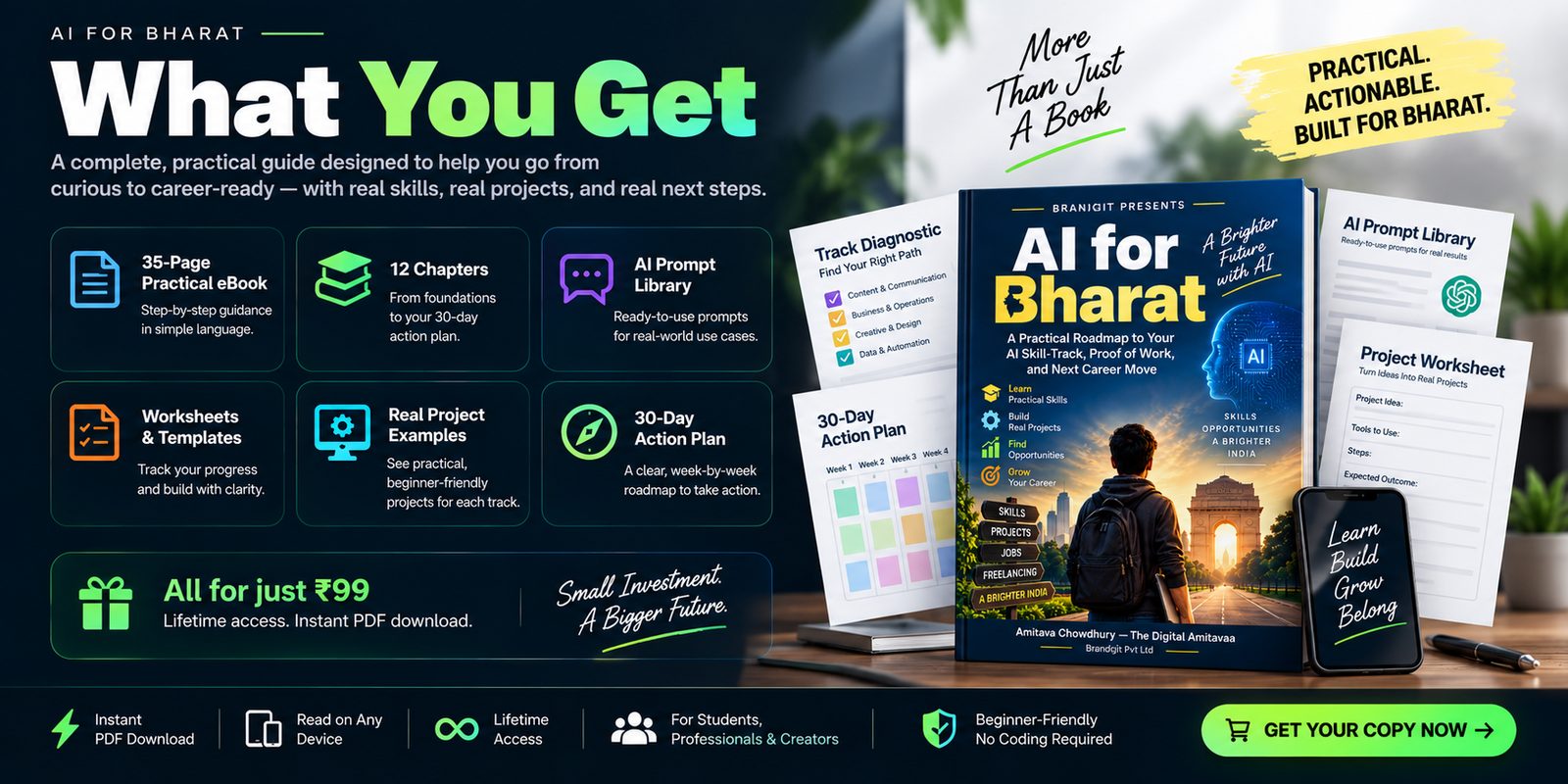
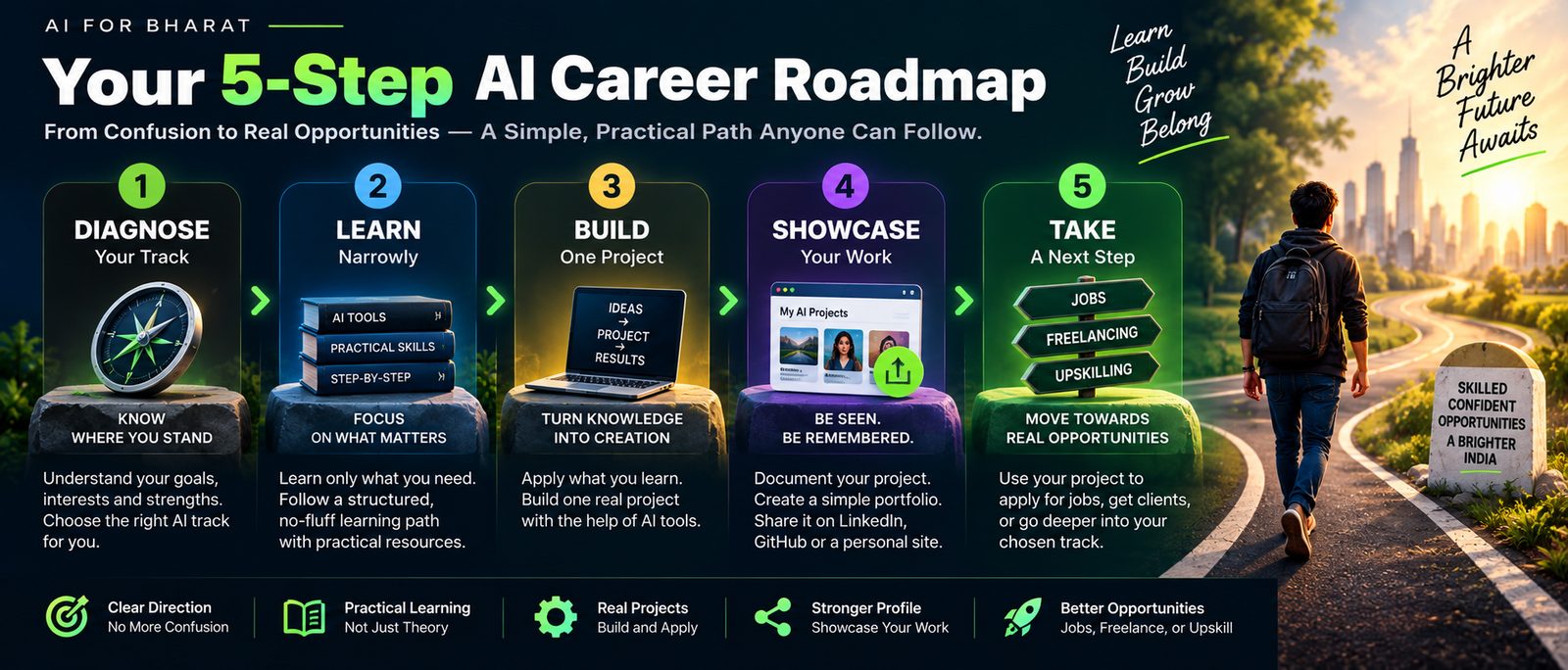
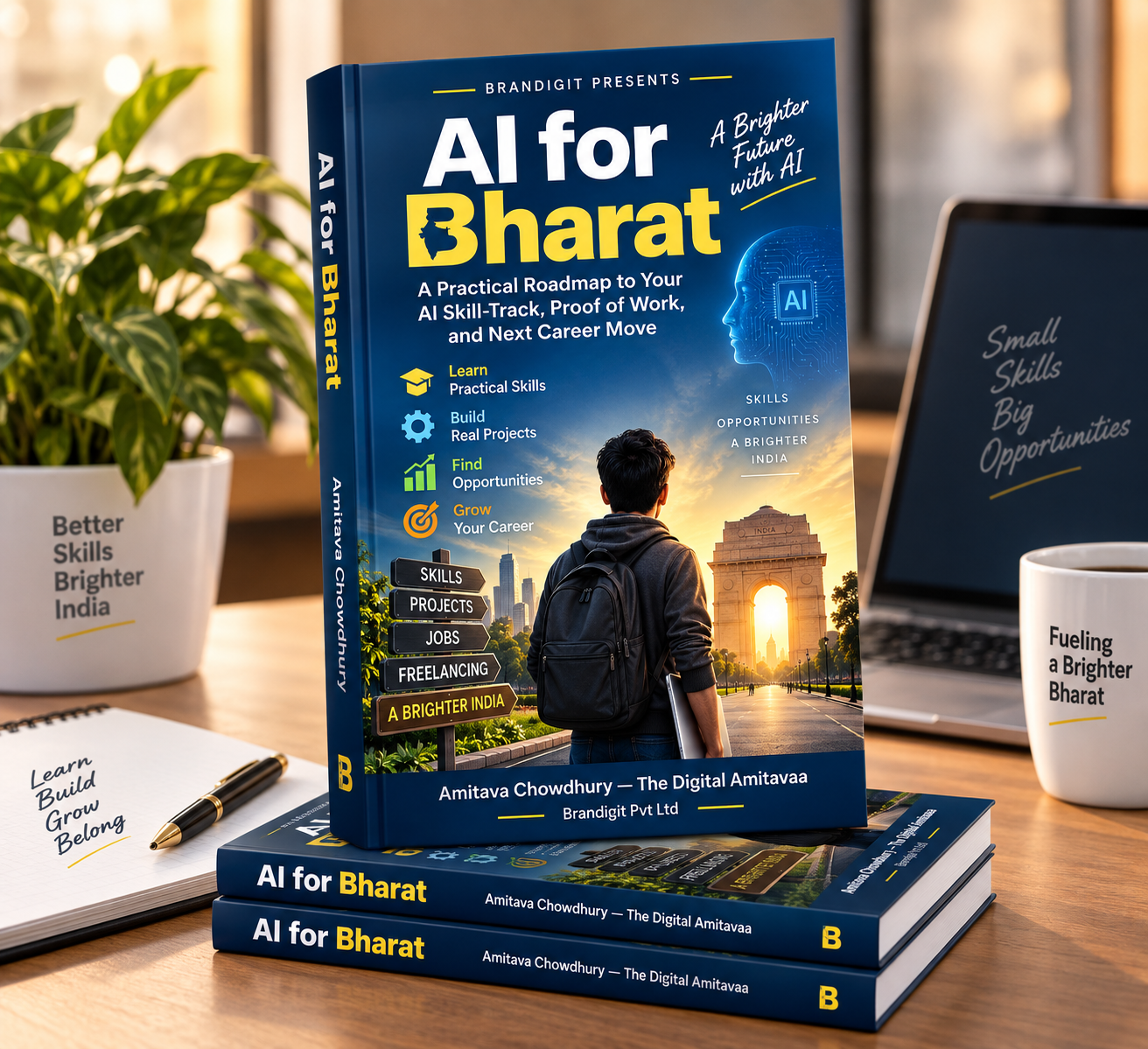
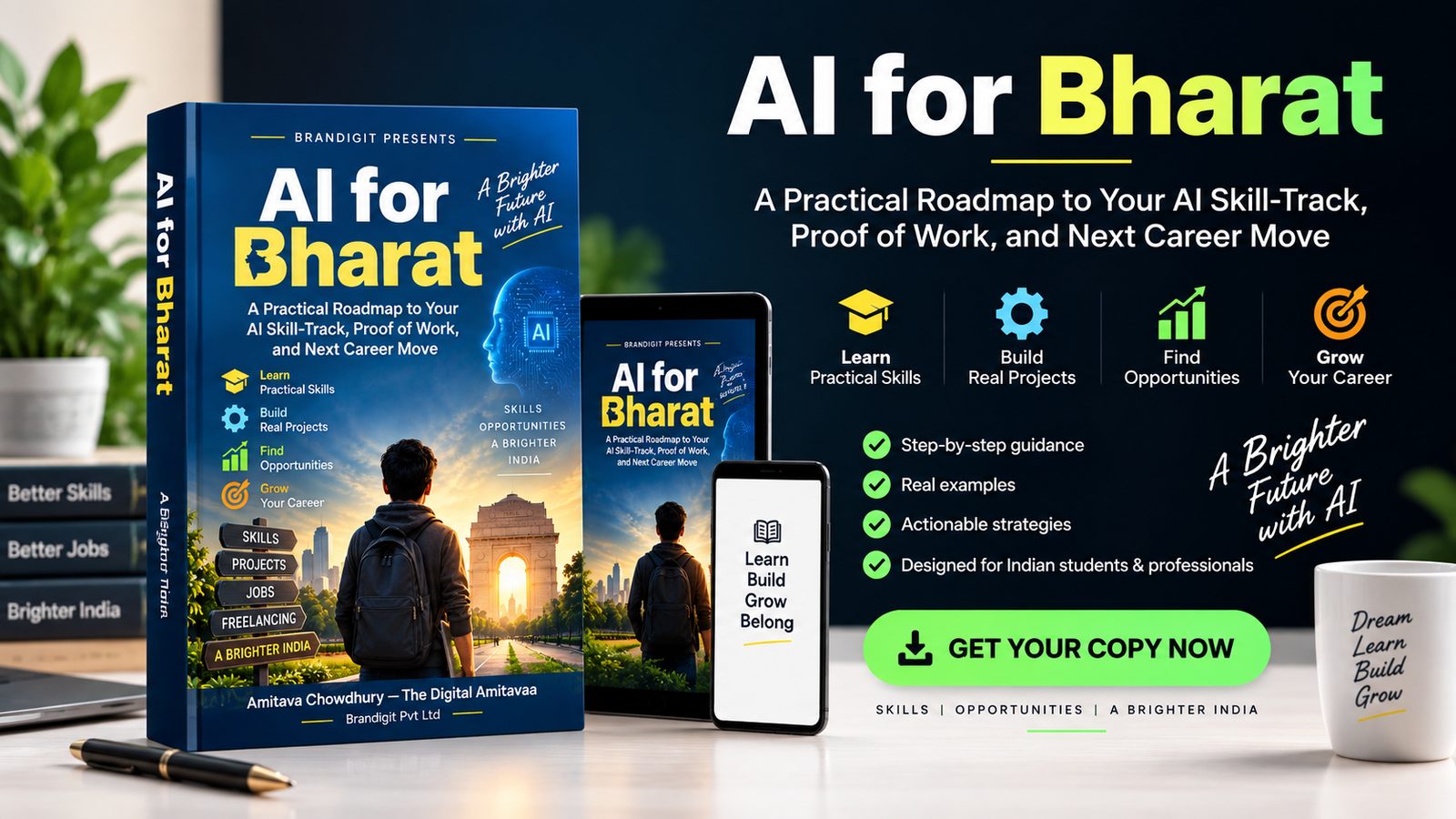
AI for Bharat is a step-by-step roadmap for Indian students, freshers and early-career professionals: find your AI track, build one real project, show it, and take your next career step.
One-time payment · PDF delivered to your email · No subscription
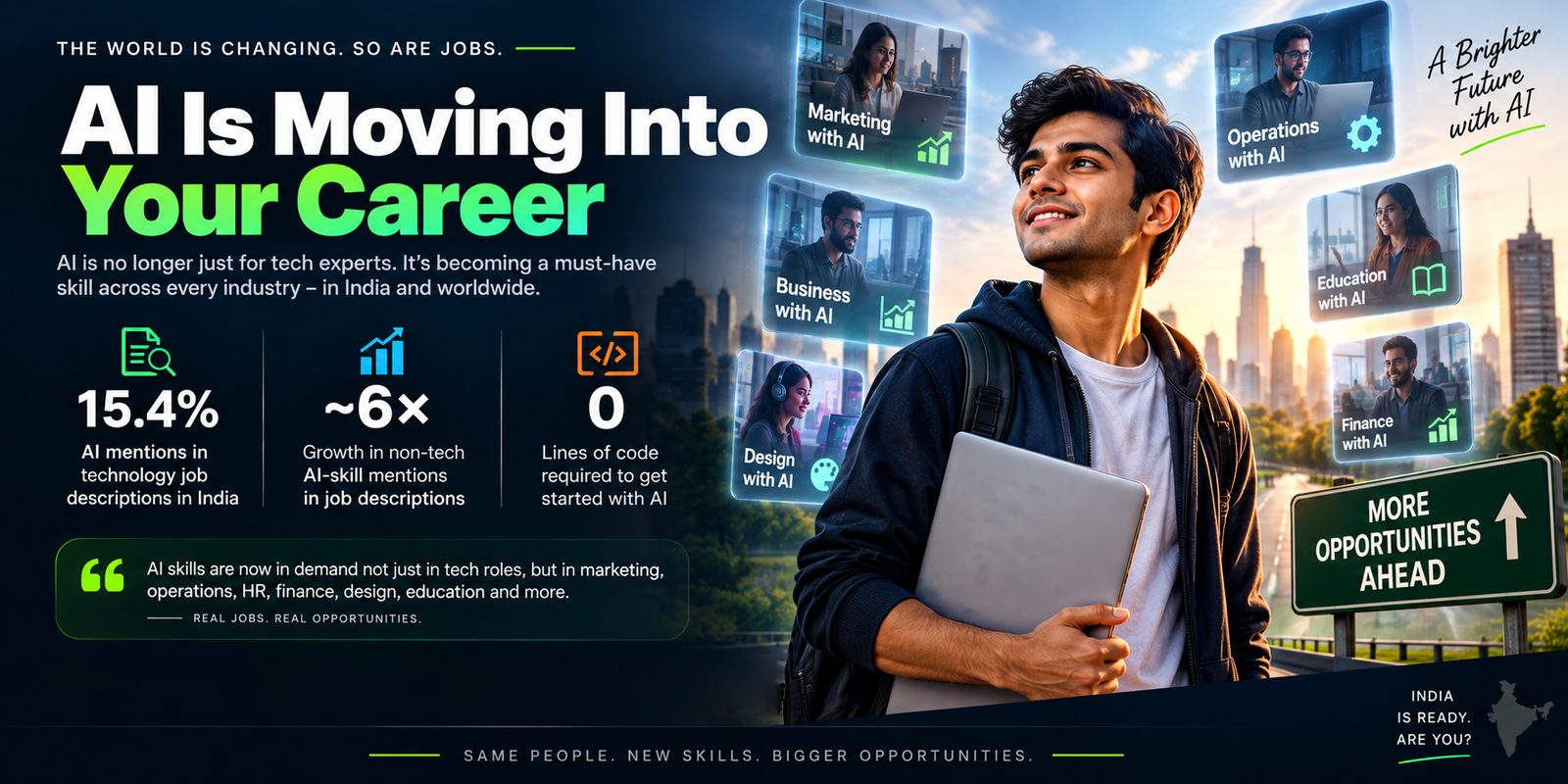
Source: Naukri World AI Day Report 2026.
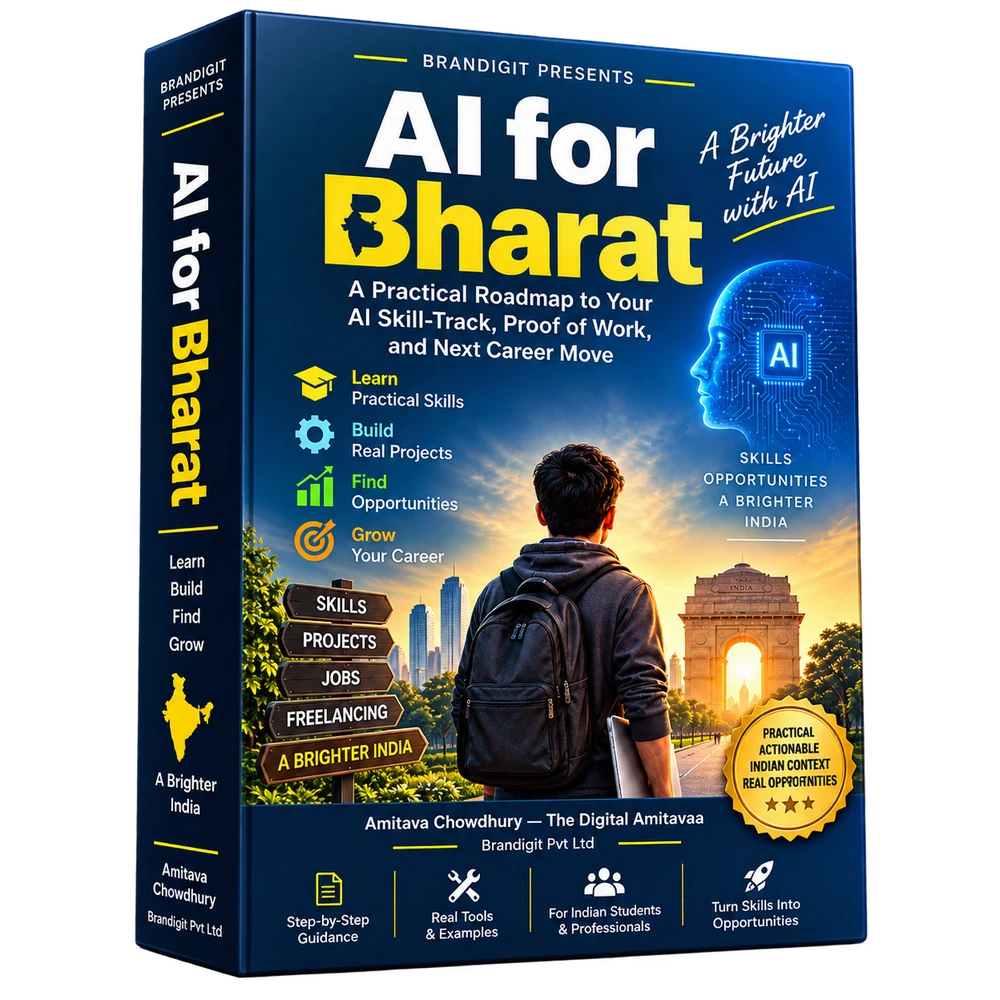

Most "learn AI" content is built for engineers, built for clicks, or built to sell you a hundred tools. Very little tells you what to do this week. This book gives you one sequence instead:
A 5-question diagnostic sorts you into one of four no-code tracks, with a tie-breaker for when you land between two.
A scoping template plus a day-by-day walkthrough for each track, sized for one to two weeks of part-time effort.
Two per track, each with how to use it, what to expect and how to improve it after the first run.
How to describe what you directed, edited and decided, for LinkedIn, your resume and a simple portfolio.
How to handle "What AI skills do you have?", "How do you check AI output?" and "Won't AI replace this role?"
Week-by-week steps, fill-in worksheets and a common-mistakes self-audit, so momentum doesn't fade by day five.
Not forty options. Four practical starting points, each with a starter toolkit and a sample project.
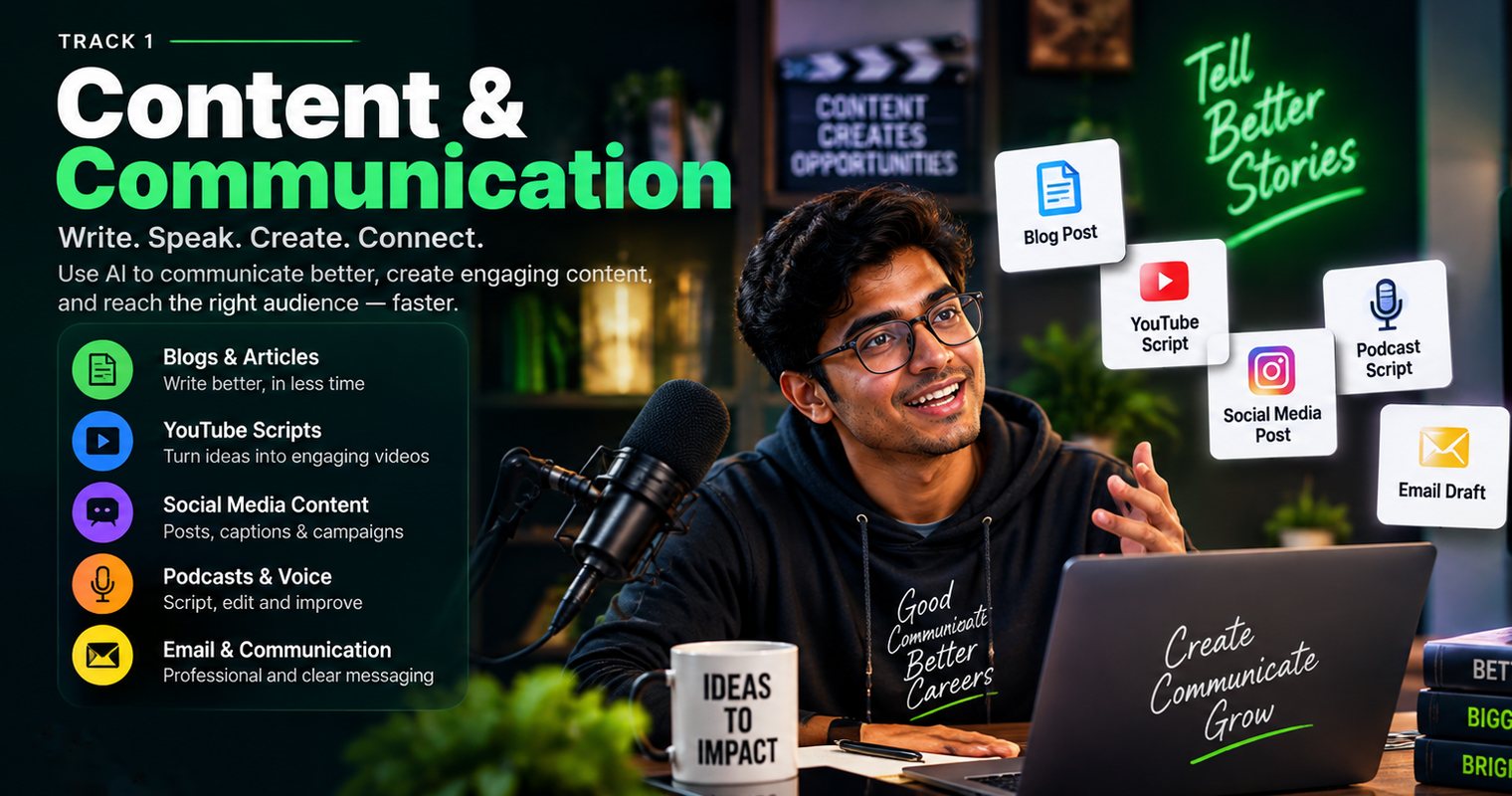
Track 1For marketing, journalism, teaching, HR and social media. You'd build a five-part AI-assisted content series, edited for accuracy and voice.
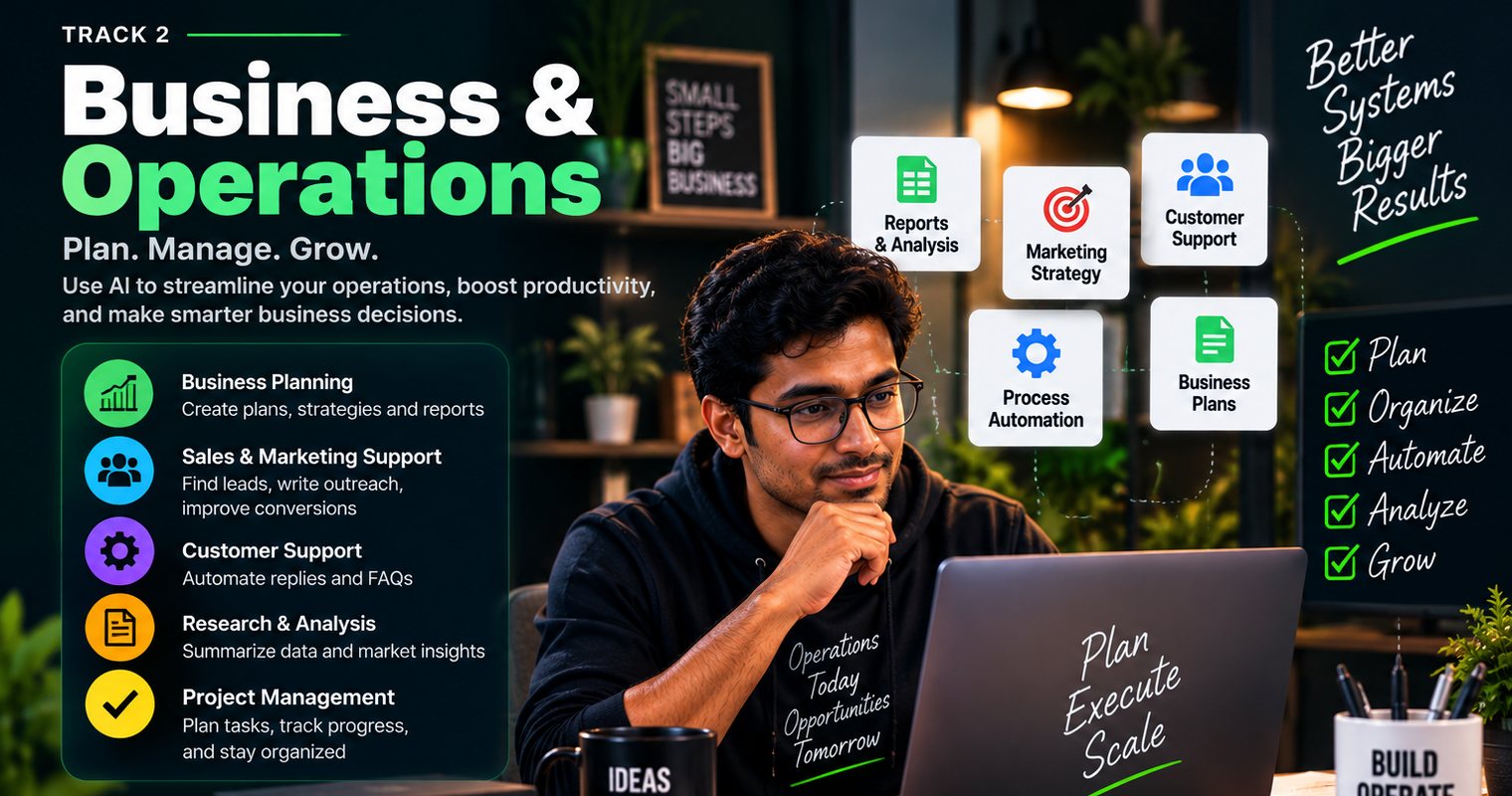
Track 2For operations, sales, support and analysis. You'd build a before-and-after case study that ends in a specific, verified recommendation.
Track 3For design, media and advertising. You'd build a small campaign concept: 3 to 5 AI-assisted visuals with your creative reasoning.
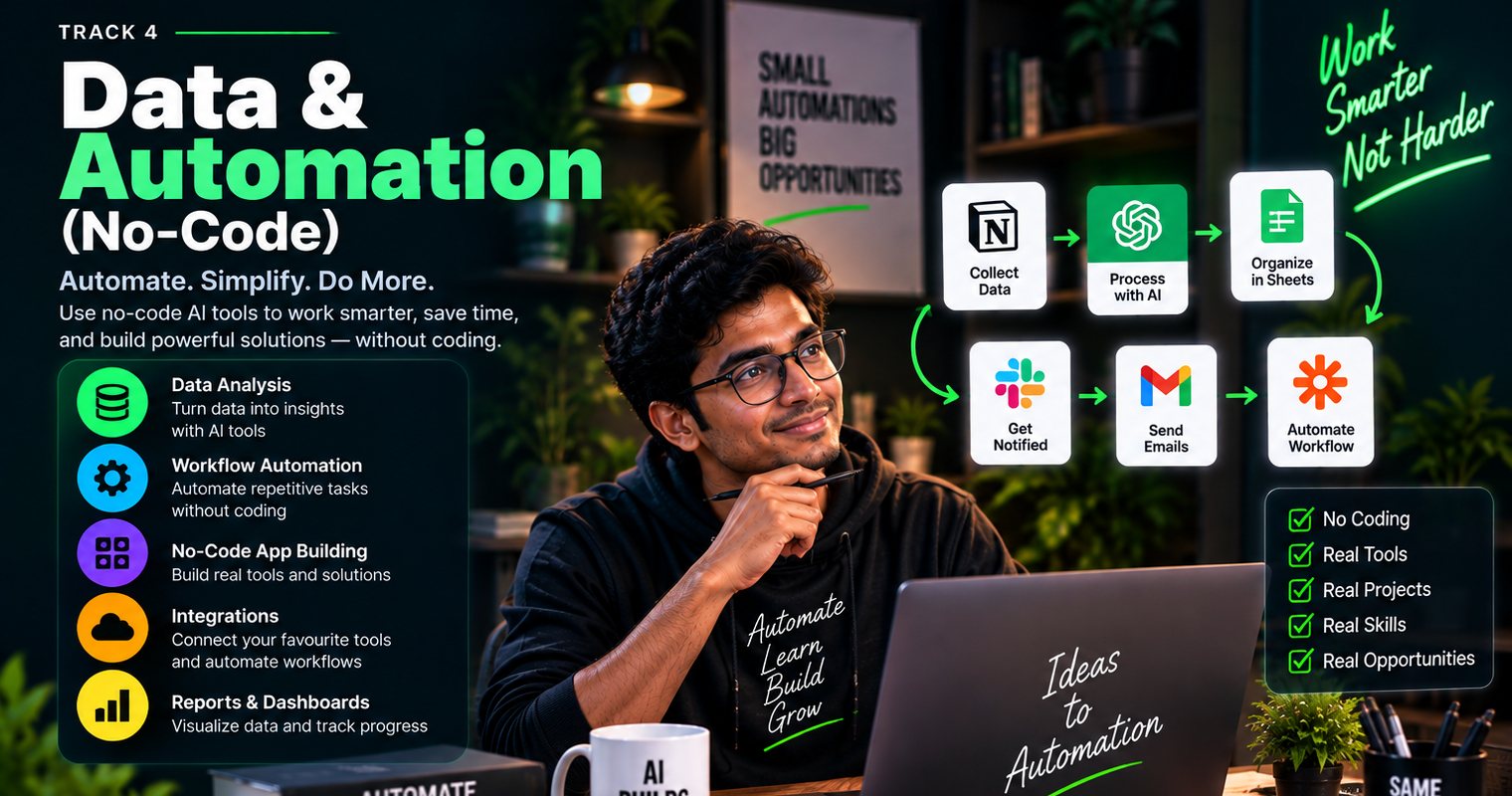
Track 4For builders and small-business owners. You'd build one working automation and document the logic in plain language.
Answer these five questions honestly — based on where you are right now, not where you think you should be. Your track falls out of the answers.
If you land on two tracks, pick the one closer to your current field — proof of work is more credible when it connects to something you already have context in.
A finished small proof-of-work project you can explain in under two minutes is the most credible thing you can show a recruiter or client. The book walks you through building one, day by day, for your track.
A peek at how the book's day-by-day walkthroughs actually work. Adapt the same shape to whatever specific project you scope.
Choose one concept from your field that you understand better than most people your age. "Marketing" is too broad; "why most college fests waste their Instagram budget on the wrong week" is specific enough for five posts.
For each post, give the AI a clear brief: angle, audience, length. Generate first drafts for all five before editing any — this stops you over-polishing post one and running out of steam by post five.
The real work. Cut anything generic, add one specific detail only you would include, verify any fact the AI supplied that you didn't. This is where the skill shows.
Order the five posts so they build on each other, write a one-line hook for each, and do a final read-aloud pass. Anything awkward out loud usually reads as AI-generated too.
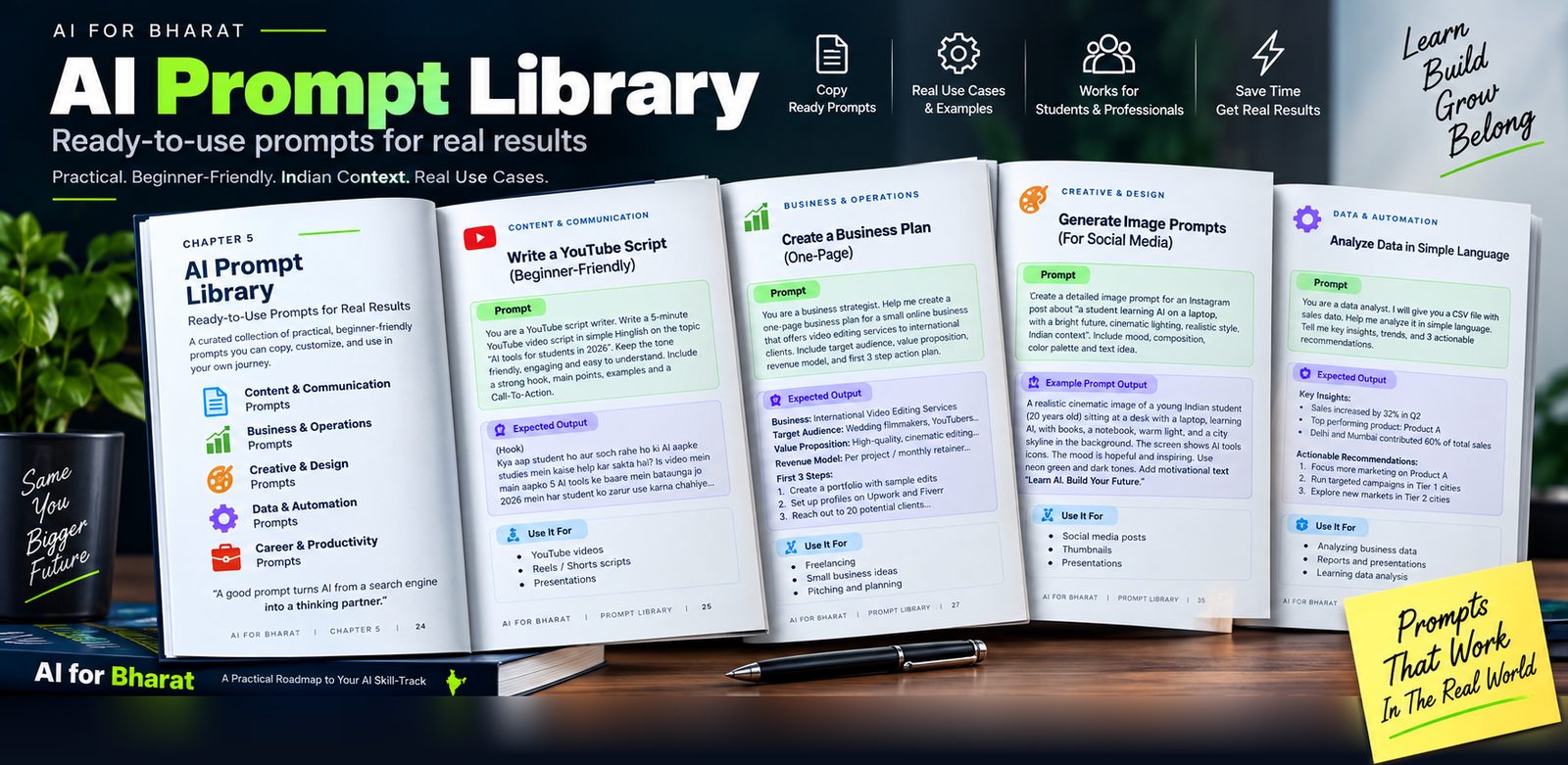
Two starter prompts per track. Copy them, run them once, then deliberately edit them based on what came back — that editing instinct is the actual skill.
Paste one piece of writing; rewrite it as a 3-line summary, a 5-post social series, and a short intro email. Keep your original facts — don't invent new ones.
Same explanation, two versions: one for a complete beginner, one for someone experienced who wants only the non-obvious details. No new information.
Paste a batch of customer or user comments; ask for the top 5 recurring themes with sentiment and one real example per theme from the text provided.
Paste your raw notes; get a structured report draft with a one-line summary, 3–4 findings and one recommendation — to edit, not to ship as-is.
Turn a vague idea into a brief detailed enough to get usable AI output: purpose, audience, mood, key elements, style references. Generate 3 distinct concept directions.
Take a first AI output you like partly but not fully. Specify what to keep and what to change. Push toward something usable without starting over.
Describe a manual process in plain language. Break it into an "if this, then that" sequence, flag anything too ambiguous to automate.
Paste your automation logic; generate 8–10 test cases including edge cases and likely failure points before trusting it with real data.
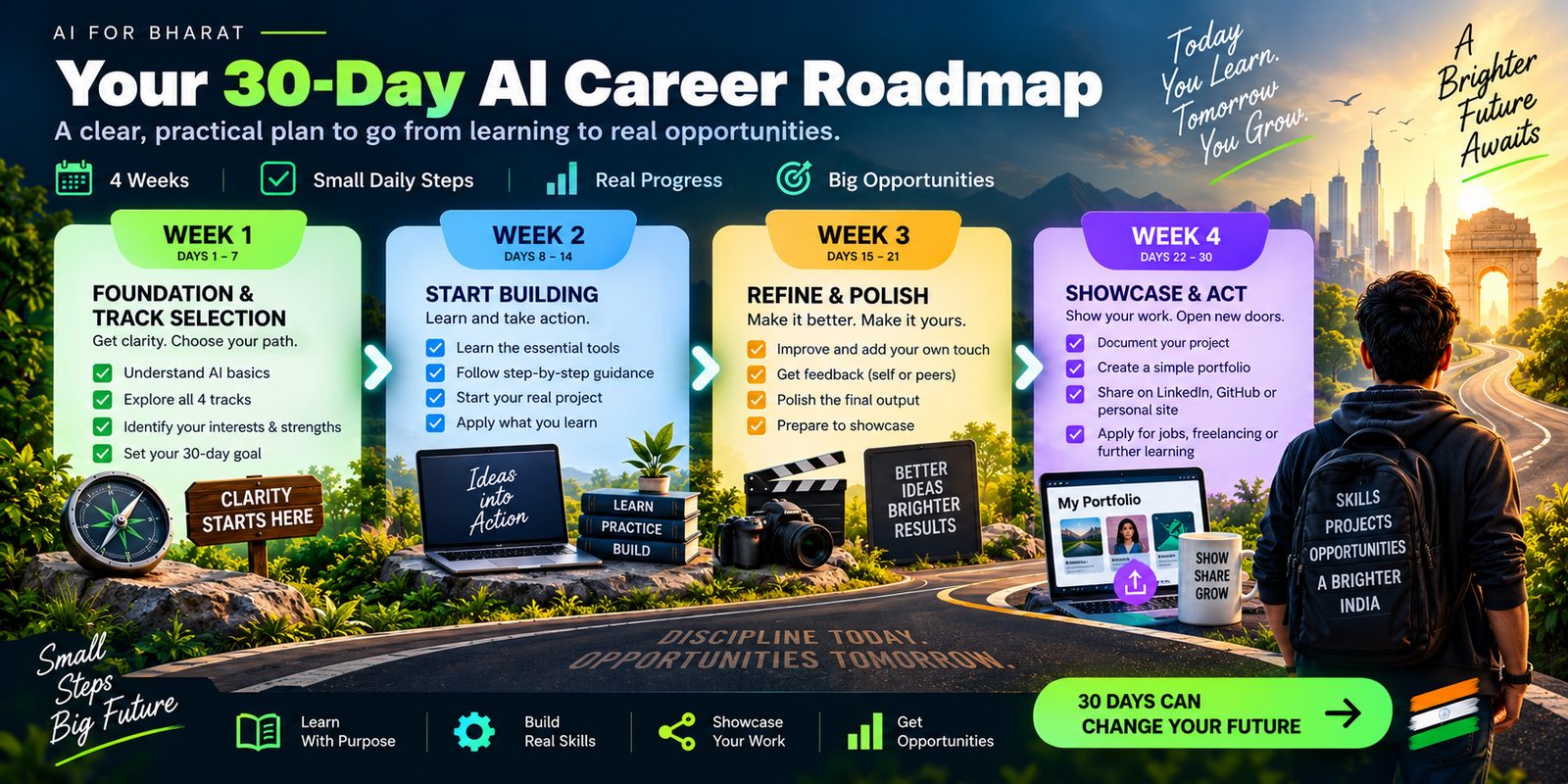
Job descriptions in India are asking for AI skills more every year, first in tech and increasingly beyond it. You don't need to code or learn everything. The four weeks below turn the book's method into a plan: choose your track, build one proof-of-work project, refine it, then showcase it and take your first concrete step.
A consolidated reference of traps the book calls out by name — so you can name them in yourself before they cost you another month.
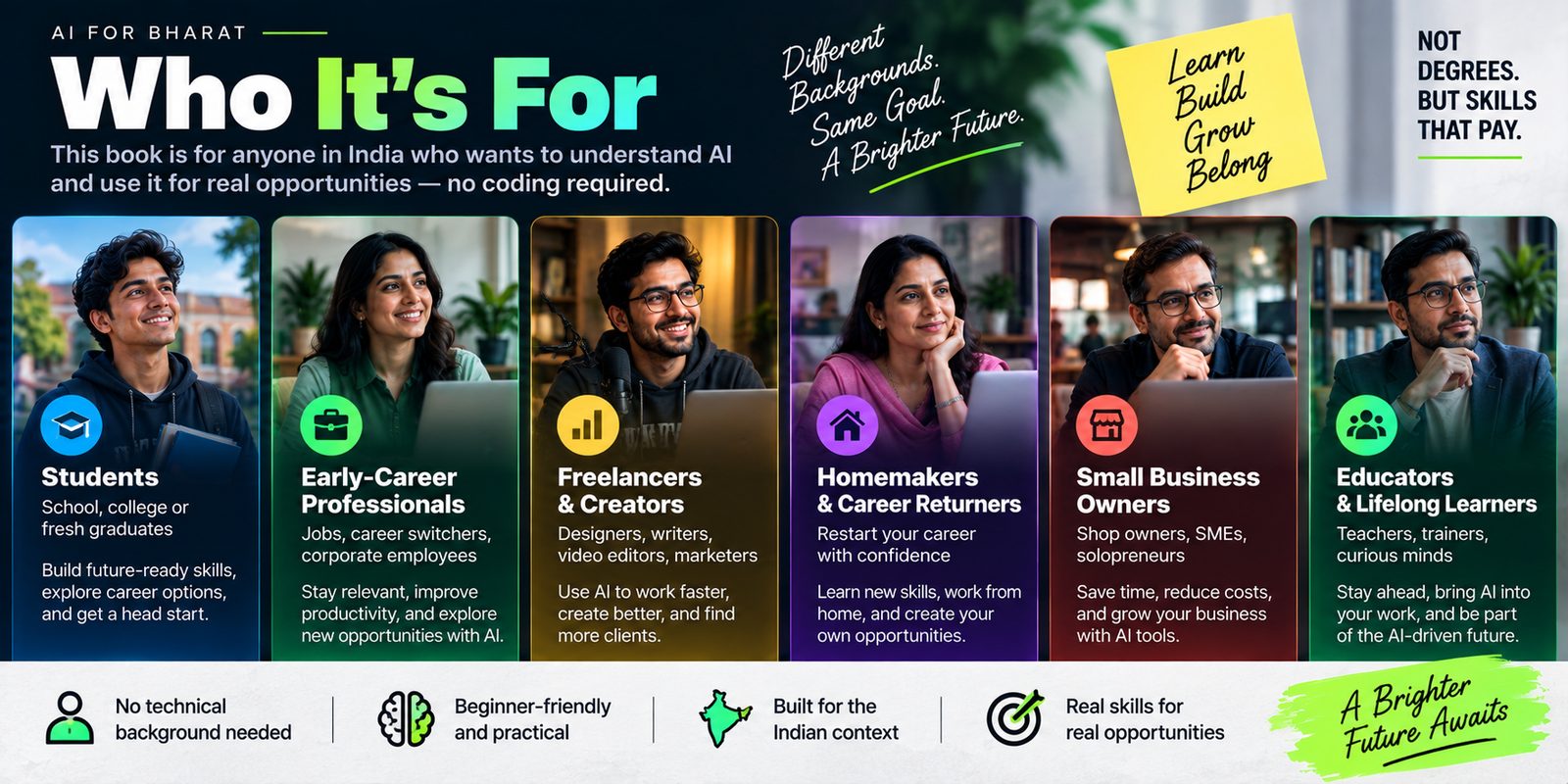
AI for Bharat is written for beginners in India, especially final-year students, freshers and early-career professionals in non-technical roles. Freelancers and small-business owners will find a track that fits too, and no coding is needed. Read the two lists below, and if you recognise yourself in the first one, you're in the right place.
No job. No salary figure. No guaranteed income. Anyone promising that hasn't done their homework on how hiring actually works.
What it will do is remove the biggest obstacle most beginners face — not knowing where to start — and replace it with a clear, personal plan you can act on this week.
That's the entire promise: not "learn AI" in the abstract, but identify your track, build something real, and act on it.
No. Everything in the book assumes you don't. It's about using existing AI tools with skill and judgment, not building AI systems.
A 35-page PDF eBook, delivered to your email after payment. Read it on your phone, tablet or laptop.
It's tool-agnostic on purpose. Tools change fast, so it teaches skills first and suggests starting with the free tier of a general AI assistant you already have access to.
No book can promise that. It gives you a track, a finished project you can show, and a concrete plan. What you do with them is up to you.
Yes, especially if your role is non-technical and you want to build AI capability without switching into engineering. The book includes a path for going deeper within your track.
Pick your track. Build one real thing. Show it.
One-time payment · PDF delivered to your email · Lifetime access
Need help? info@thebrandigit.com · +91-9147371201